Your next ideas are already in your notes
A new idea is born when two sources read at different times meet. The material is already there; what is missing is the movement that puts them face to face — convergences, contradictions, blind spots.
The material is already there
Four hundred notes. Maybe a thousand. Serious sources, relevant highlights, a folder tree kept in order. Objectively, a considerable body of work.
Your notes hold far more than what you put into them. Each source went in alone, but they are not alone: between two of them, read eight months apart, there is a contradiction, a parallel, a lead. That is often how an idea begins.
So what is missing is not material. It is the movement that puts two sources face to face — and no base does that on its own.
Yet the reflex is to add more: not enough notes for critical mass to kick in. It is the other way round — the bigger the base grows, the less you go back to it.
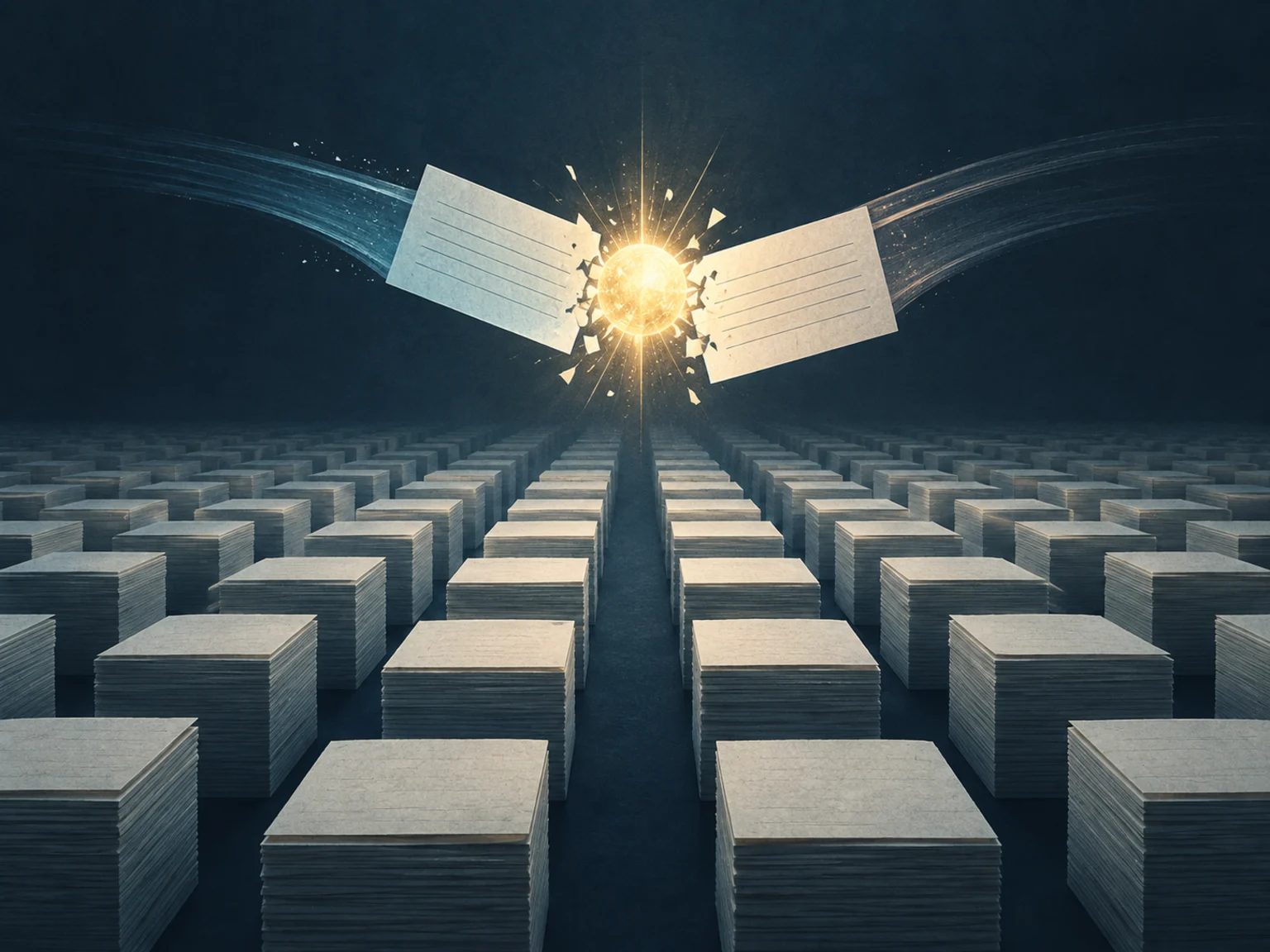
A new idea is a collision
Look at where your ideas really come from. Almost never from a single document, however good. They come from a clash between two things read at different times:
- an economist explains that measuring a performance distorts it; six months later, a manager describes a bonus scheme that degraded service. These two sources never met, and yet one explains the other.
- a study concludes that sleep consolidates memory; another researcher takes its protocol apart. The tension between the two is worth more than either on its own.
A conventional base never provokes that meeting. It files two notes that should have collided side by side, in two different folders. They do not collide, because nothing puts them face to face.
Manual linking is not enough
The immediate objection: that is what links are for. You link, the graph builds up, the connections appear.
Except that a manual link has a structural limit. You can only link what you have already seen.
By the time you place the link, you have already made the connection in your head. The graph records it; it does not produce it. It preserves your past thinking; it manufactures none.
Worse, it requires both notes to be in your mind at the same moment. But you read the first eight months ago and the second this morning. You will never place that link, because the first is no longer in your working memory when the second arrives.
A knowledge graph makes a relationship explicit and queryable — that is real and useful. But it only answers questions whose premises you have already laid down.
What would need doing on your behalf
The missing work is mechanical, which is exactly why it never gets done: nobody has time to reread a thousand notes looking for interesting pairs.
It comes down to three questions, asked across a whole corpus rather than of a single document:
Where do my sources converge? Three independent authors arriving at the same finding, without citing one another, are worth more than one asserting it. Convergence is a reliability signal you cannot see while reading one source at a time.
Where do they contradict each other? This is the most productive one. Two sources in disagreement force you to decide, or to understand why they diverge. A tension spotted is the start of a thought; a tension never seen is a mistake waiting to happen.
What does none of them say? The corpus's blind spot. If your twelve sources on a topic share the same assumption, that assumption deserves questioning — and it stays invisible as long as you read one source at a time.
From the base to the gesture
So what is missing is neither volume nor a better folder tree: it is a movement that takes several sources together and makes them answer one another.
Once that movement happens, something changes in how you use the base. You no longer go to it to retrieve a document — you go to it to see what your sources say together about a question. It is no longer an archive; it is an interlocutor.
And only then does the promise hold. Not because the machine has an idea on your behalf: it has none. But because it sets before you, at the same time, two things you read eight months apart and would never have brought together.
The idea remains yours. It was already there, split between two sources that had never met.
Frequently asked questions
- Doesn't a link graph already produce connections?
- It shows the links you placed yourself. So it only ever reveals what you already knew how to connect at the moment you connected it — never what you had not seen.
- Should I keep fewer notes and reread them more?
- Rereading helps, but it is serial: you revisit one note at a time. Confrontation means holding two sources together, which a linear reread almost never does.
- What separates a convergence from a tension?
- A convergence reassures: two independent sources say the same thing. A tension compels: they contradict each other, and you have to decide or understand why. It is the second that produces thinking.
Published 2026-09-05