We have never had access to so much information. Here is how to get more out of it
You get more out of what you read by fixing retrieval: what survives six months is the shape of an idea, yet finding a document demands the exact words you once had in front of you. Searching by meaning removes that gap.
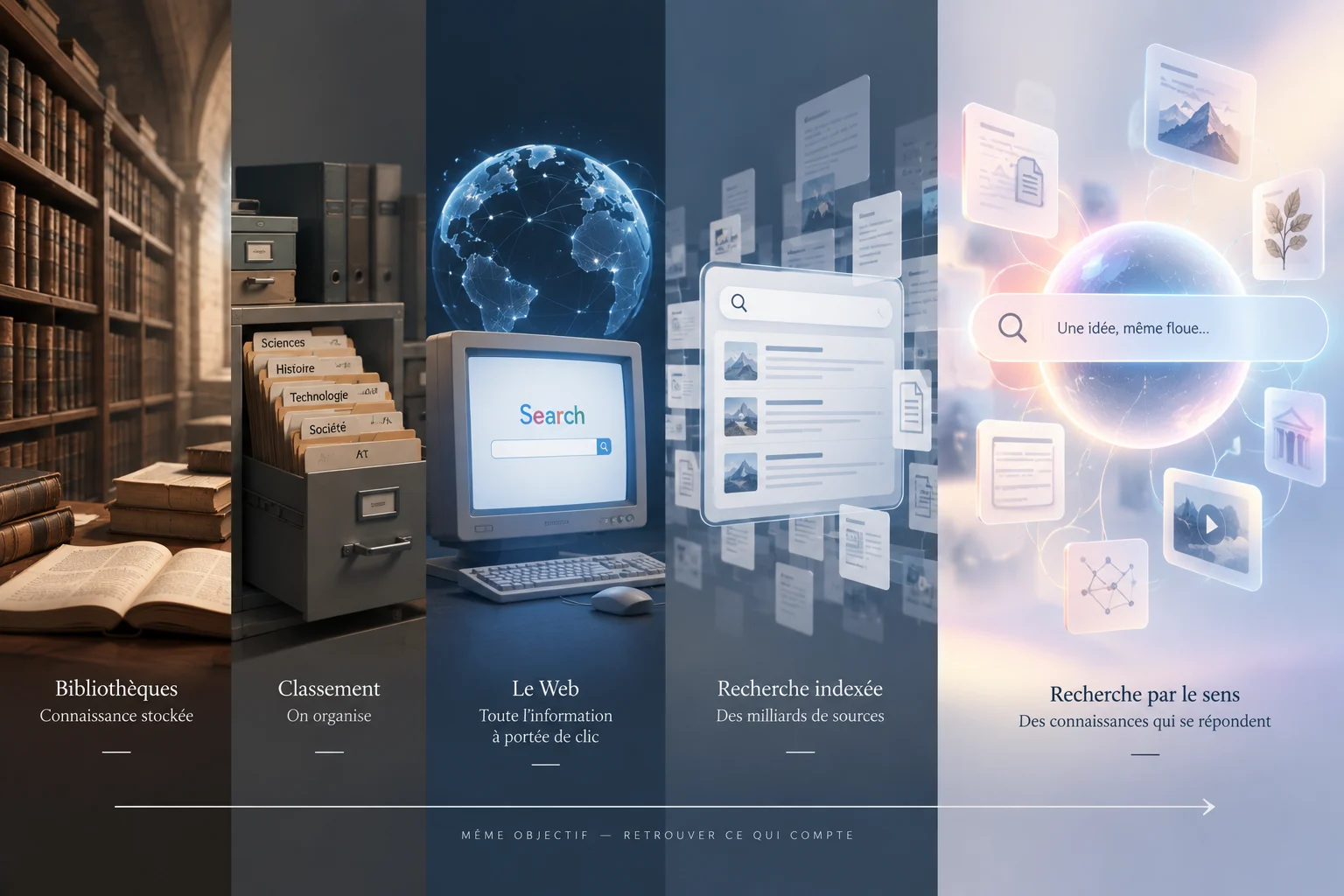
Raw material nobody has ever had before
You read more than any generation before you. Articles, threads, newsletters, long-form videos, hour-long podcasts. A quantity of material that a researcher last century would have spent years assembling passes in front of your eyes in a week.
That is an enormous advantage, and it is almost entirely wasted.
Try it: name three precise ideas from an article you read three months ago. Not the topic — an idea, with its argument. Most people cannot.
This is not a lapse of attention, nor a sign that you read badly. It is structural, and it can be fixed — not by reading less, but by changing what happens after you read.
It is not memory that fails
The reflex explanation blames memory: too much information, a saturated brain, fragmented attention. That is the information overload thesis, and it describes something real.
But it misses the precise mechanism.
Your memory works perfectly well. It holds on to meaning: that someone took apart the myth of multitasking, that a piece changed your mind about remote work, that a study linked sleep and learning. What you have lost is not the idea — it is the path back to the document.
And that is where the mismatch lies:
| What your memory keeps | What search demands |
|---|---|
| "Something about metrics that turn against us" | Goodhart's law |
| "The study on attention in open-plan offices" | task resumption cost |
| "The passage that takes apart multitasking" | attention switching |
You remember the meaning. You are asked to search by the words. None of those queries gets anywhere in a keyword engine.
The real cost: trust
The failure does not stop at the lost note. You pay for it a second time.
A store you no longer trust to give back what you put into it stops being fed. You keep reading, but you stop capturing: what is the point, if you will never find it again. The folder becomes a graveyard.
That is how a second brain dies — not through a decision to abandon it, but through quiet disinvestment. Nobody says "I'm stopping". You simply stop going there.
The three classic answers, and why they hold up badly
File things better. Folders, tags, hierarchies. Filing assumes that, at the moment of capture, you know the angle from which you will search later. You never do: the article filed under "productivity" will be searched for two years later as an argument about the attention economy.
Take more notes. That moves the work without solving it. A note rewritten by hand is subject to the same problem: you will have to find the note, using the vocabulary you had at the time.
Re-read regularly. Spaced repetition works — for a closed corpus you have decided to memorise. It does not scale to everything that passes in front of your eyes in a week.
All three fail for the same reason: they demand discipline sustained over time, and the bill comes due at the moment of capture, when motivation is at its lowest.
What actually fixes it
The problem is not filing better, it is searching differently.
A search that compares strings of characters will never retrieve a memory phrased another way. You need a search that queries meaning — one that can surface "unintended effects of bonuses" when you type "perverse incentives".
That is what hybrid search does: a semantic engine that compares meanings, merged with a lexical engine that keeps the exact words when they matter — a proper noun, a reference, a figure. The two scores are combined, not stacked.
With one point of rigour that changes everything in practice: a search that matches nothing returns nothing. Not three neighbouring documents to save face. A candidate must both stand out clearly from the rest of the corpus and clear an absolute floor. That is what separates an answer from polite noise.
What it changes day to day
You no longer have to remember your own words. You search for the idea as it comes back to you — approximate, rephrased, in everyday language — and the source surfaces, with the exact passage.
From there, capture pays off again. You capture because you know you will find it, and because you find it, you keep capturing. The loop that had broken closes again.
It is a modest shift in the wording, decisive in practice: the problem with digital reading was never reading too much. It is reading without ever being able to go back.
Frequently asked questions
- Does reading less help you retain more?
- Partly, but that treats the symptom. The problem is not how much you read, it is the absence of any usable trace once you have finished. Ten articles captured well beat three read carefully and then lost.
- Is taking notes enough to stop forgetting?
- Not if the note cannot be found again. A store of notes you no longer query is a graveyard: it cost time to write and gives none back when you need to read.
Published 2026-09-06