Your note-taking system asks too much of you
A note-taking system fails when its maintenance cost is paid at capture and its payoff arrives months later. The gap between the two is what kills the habit, not a lack of willpower.
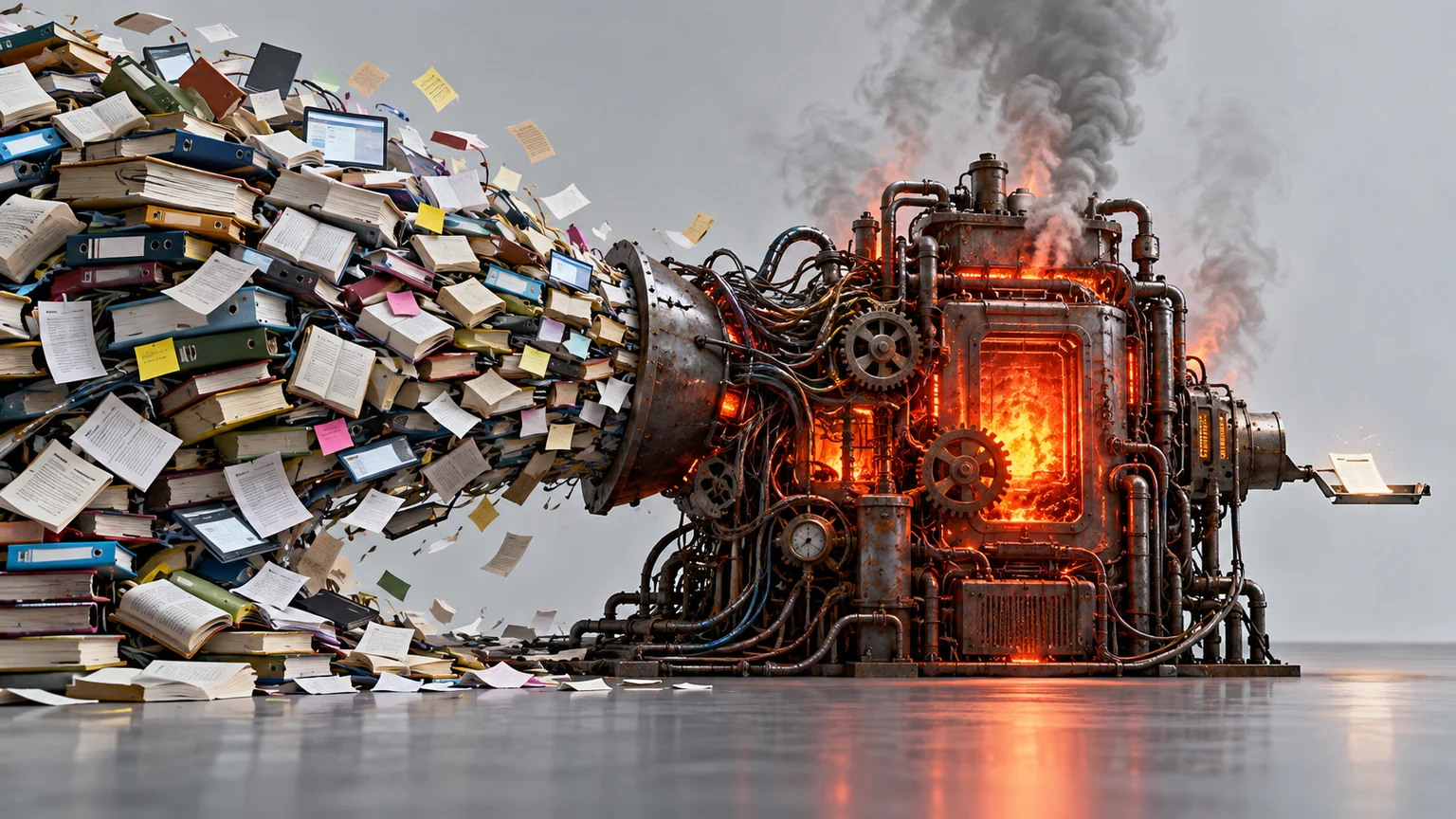
The sum nobody does
You adopted a method. PARA, Zettelkasten, a well-designed Notion, an Obsidian vault with its plugins. At first it all holds: the structure is clear, the first notes come one after another, the graph fills up.
Three months in, capture slows. Six months, it stops. A year on, you reopen the folder out of curiosity and close it again.
The usual explanation is discipline: you did not keep it up. That is convenient for the method, unfair to you, and above all wrong.
Let us do the sum the methods never do. For a single article captured properly:
| Step | Time |
|---|---|
| Save the source | 30 s |
| Read while highlighting | reading time |
| Rewrite as an atomic note | 5 to 15 min |
| Tag, file, decide where it goes | 2 to 5 min |
| Link to existing notes | 3 to 10 min |
Count on ten to thirty minutes per source, on top of the reading. At ten sources a week, that is two to five hours. Every week. Indefinitely.
The real problem is not the volume, it is the gap
Two to five hours a week would be acceptable if the payoff came quickly. It does not.
You pay the cost now, right after reading, when your attention is already spent. You collect the payoff months later, when the note resurfaces at the right moment — if it resurfaces at all.
That gap is what kills the habit. No amount of willpower holds out for long against a certain, immediate expense set against an uncertain, distant gain. That is not a character flaw, it is basic economics.
Worse still: the gain genuinely is uncertain. A rewritten note is still subject to the retrieval problem. You wrote it with the vocabulary you had at the time; you will search for it with the vocabulary you have today.
Separate what you write from what you read
The underlying mistake is handling two very different things with the same tool and the same standard.
What you write — your thoughts, your objections, your conclusions — deserves the effort. That is where rephrasing makes sense: writing is thinking, and the slowness is the benefit, not the cost. Zettelkasten is excellent for this.
What you read does not. Summarising an article is not an act of thought, it is a mechanical act. Doing it by hand means doing by hand what a machine does properly — and doing it worse, because you will do it tired, at the end of a read, when you already want to move on to something else.
PKM methods were designed before the second task could be automated. They still include it out of inheritance.
Where to cut, concretely
Three tasks are purely mechanical. None of them calls for your judgement:
Transcription. An hour-long video, a podcast: the text exists, it just needs extracting. There is no decision to make.
Summarising and pulling out the key points. A first pass that isolates what the source says. It is not your reading — it is the base your reading stands on.
Retrieval. Finding a passage six months later has never been intellectual work. It is an indexing problem, and it is a search engine's job to solve it.
What remains after those three cuts is exactly what is worth your time: deciding what matters, disagreeing, connecting two ideas nothing had brought together, drawing a conclusion.
The test to apply
Look at your system and ask one question, honestly: am I still feeding it?
If yes, it holds. Change nothing.
If not, do not go looking for the next method — the migration will cost you three weekends and bring you back to the same place. Look instead for what, in the act of capturing, had become too expensive for what it returned. It is almost always the same spot: the mechanical work you were doing by hand, and the well-founded fear of never finding it again.
Frequently asked questions
- Should you give up on note-taking methods altogether?
- No. The methods work for what you write yourself: thoughts, drafts, meeting notes. They collapse when you ask them to absorb everything you consume on top of that.
- Does PARA or Zettelkasten solve the problem?
- They organise better, but they do not reduce the work at capture — Zettelkasten actually adds to it, since every card has to be rewritten in your own words. That is justified for what you think, and expensive for what you read.
- What should be automated first?
- Transcription, summarising and search. Those are the three mechanical tasks: they call for no judgement, they cost time, and they fall due at the worst possible moment — right after you finish reading.
Published 2026-09-03