Storing information is not building a memory
Storing keeps content; remembering means retrieving it by meaning, tying it back to its source and testing it against everything else. A repository that offers nothing but storage is not a memory, however large it grows.
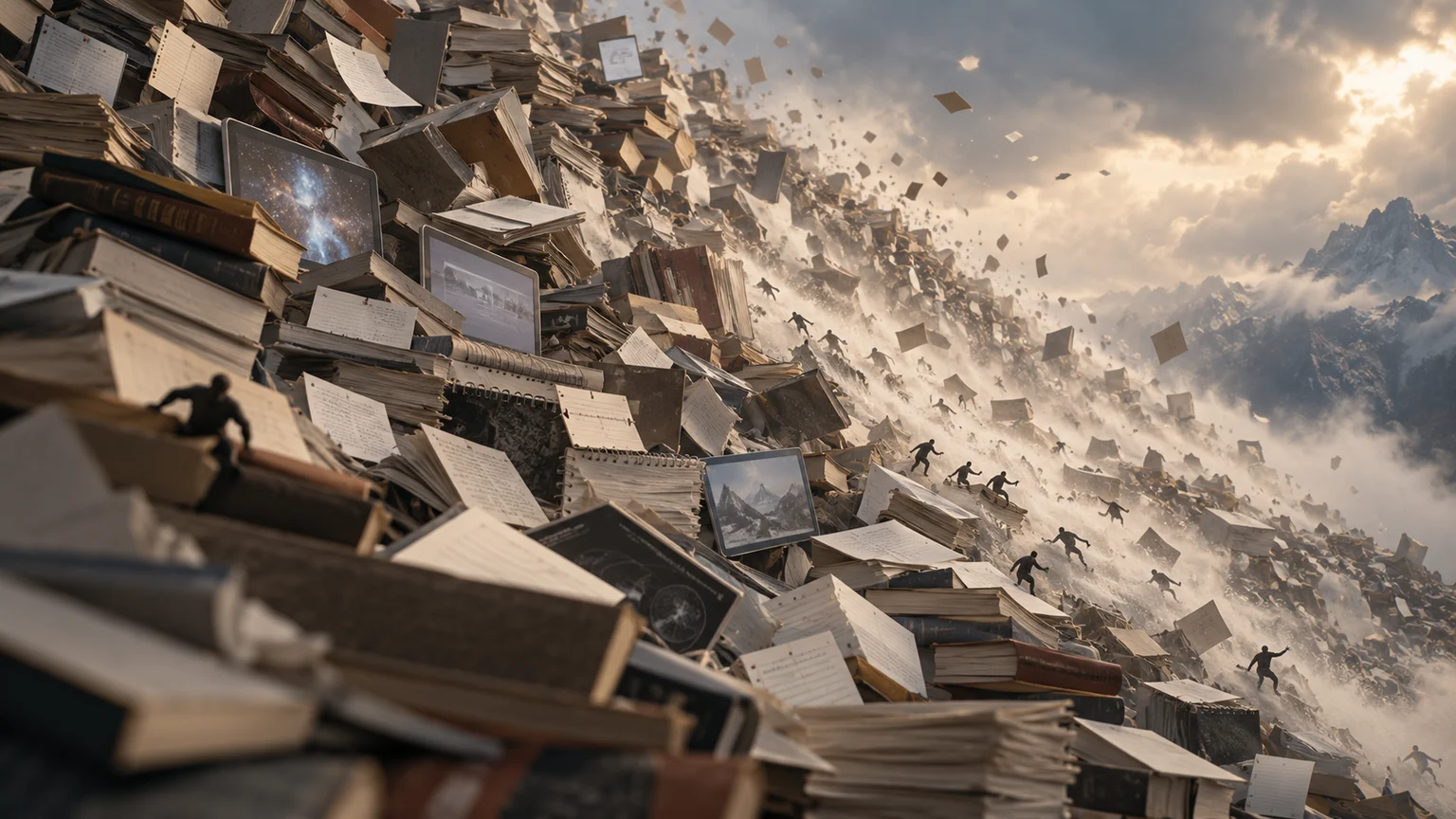
A hard drive remembers nothing
It keeps. That is something else entirely.
The difference looks like a matter of vocabulary; in practice it decides everything you can expect from a tool. Most note-taking systems are excellent storage devices sold as memories, and the gap between the two is precisely what disappoints in daily use.
A memory requires three properties. None of them is storage.
First property: you reach it through meaning
You do not retrieve a memory by its address. You do not open drawer number 47. An idea comes back to you through another one, through a resemblance, through a smell — never through an identifier.
A conventional repository works exactly the other way round: by path (folder, tag) or by exact string. Two modes of access that require you to know what you are looking for, and what you called it at the time.
The mismatch is structural. What survives six months is the shape of an idea. What the repository demands is the string of characters you typed back then. You remember the meaning; it asks you for the words.
As long as access stays lexical, the tool is a tidy cupboard — useful if you know what you are after, silent the moment the memory goes hazy. Which is to say, in the ordinary case.
Second property: every item stays tied to its origin
A reliable memory knows where it got what it asserts. That is what separates a recollection from a rumour.
A system that produces a summary without keeping the link to the exact passage puts you in an untenable position: you have a claim and no way to check it. You will not cite it. You will not reuse it in any context that carries weight. It will sit in the base and never come out.
Information you never reuse has not been memorised. It has been stored. That nuance decides the value of the entire system.
Which is why traceability is not a creature comfort but a condition: every claim must lead back to its source, ideally to the second when the source is a video or a podcast. Not to look rigorous — so that what goes into the base can come back out of it.
Third property: the items talk to each other
An isolated memory is of little use. Its value comes from what it illuminates, contradicts or confirms elsewhere.
A repository files two documents that should have collided side by side in two different folders. They never collide: nothing puts them face to face, and you read the first eight months before the second.
A memory, by contrast, brings the contradiction to the surface. It flags that three independent sources converge — which is worth more than one source asserting. It makes visible what none of them says on its own.
That confrontation is mechanical work nobody does by hand, because it means rereading a thousand notes in search of interesting pairs.
The test, in three questions
Take your current system and put the three questions to it in order. They take a few minutes to check.
Can I find an idea without remembering the words? Search for something you are certain you noted, but phrase it the way it comes back to you today. If nothing surfaces, your access is lexical.
Can I trace any claim back to its source? Take a summary your tool produced. Can you reach the original passage in one click? If not, you have a note you will never be able to do anything serious with.
Has my system ever shown me a contradiction I had not noticed? If the answer is no — and it almost always is — it keeps without confronting.
Three noes do not mean your tool is bad. They mean it does well what it was designed to do: keep. The rest was something we expected of it that it never promised.
What this changes
The practical conclusion is modest. There is no need to migrate everything or abandon what works: what you write yourself deserves a writing tool, and a good note editor is one.
But stop expecting a repository to behave like a memory. It will not, whatever method you stack on top of it. The three properties — access through meaning, traceability, confrontation — cannot be bolted on afterwards to a system that was never built for them.
A base you query is alive. A base you feed without ever querying is a well-kept graveyard.
Frequently asked questions
- What is the difference between an archive and a knowledge base?
- An archive guarantees that a piece of content still exists. A knowledge base guarantees that you can find it, check where it came from and test it against the rest. The first is a precondition for the second, not its equivalent.
- Why does traceability change the nature of a memory?
- Because a claim you cannot verify never gets reused. You do not cite what you cannot source, so you leave it lying there — and information you never reuse has not been memorised, only kept.
- Should you keep everything?
- Keeping is cheap; retrieving is expensive. So the problem is not filtering at the door but making the whole collection queryable — aggressive filtering mostly throws away what you did not yet know you needed.
Published 2026-09-02